

In the current landscape of business operations, the integration of technology has become paramount. The emergence of AI business applications has sparked debates about their effectiveness compared to traditional solutions. While machine learning in business has shown promising results, many small and medium-sized businesses (SMBs) find themselves at a crossroads when deciding which path to take. This article aims to provide clarity on the advantages and limitations of both AI tools and traditional methods, offering insights that can help SMB owners make informed decisions.
Understanding AI Business Applications

AI business applications encompass a broad range of technologies designed to enhance efficiency, automate processes, and improve decision-making. These applications leverage machine learning, data analytics, and other advanced technologies to perform tasks that traditionally required human input. The rise of these tools has led to significant transformations in how businesses operate.
Key Features of AI Business Applications
AI business applications come with a variety of features that contribute to their effectiveness:
- Automation: Routine tasks such as data entry, customer service inquiries, and inventory management can be automated, freeing up human resources for more complex tasks.
- Data Analysis: These tools can analyze vast amounts of data quickly, providing insights that would be impossible to achieve manually. This capability allows businesses to make data-driven decisions.
- Predictive Analytics: By utilizing historical data, AI tools can predict future trends and behaviors, enabling proactive strategies rather than reactive measures.
Common Misconceptions About AI
Despite their advantages, there are several misconceptions surrounding AI business applications:
- AI Replaces Human Workers: Many believe that AI will entirely replace human jobs. In reality, AI is designed to augment human capabilities, allowing employees to focus on higher-level tasks.
- AI Is Only for Large Enterprises: Some SMBs think that AI tools are too complex or costly for their operations. However, many scalable solutions exist that are tailored for smaller businesses.
Traditional Solutions: Strengths and Weaknesses
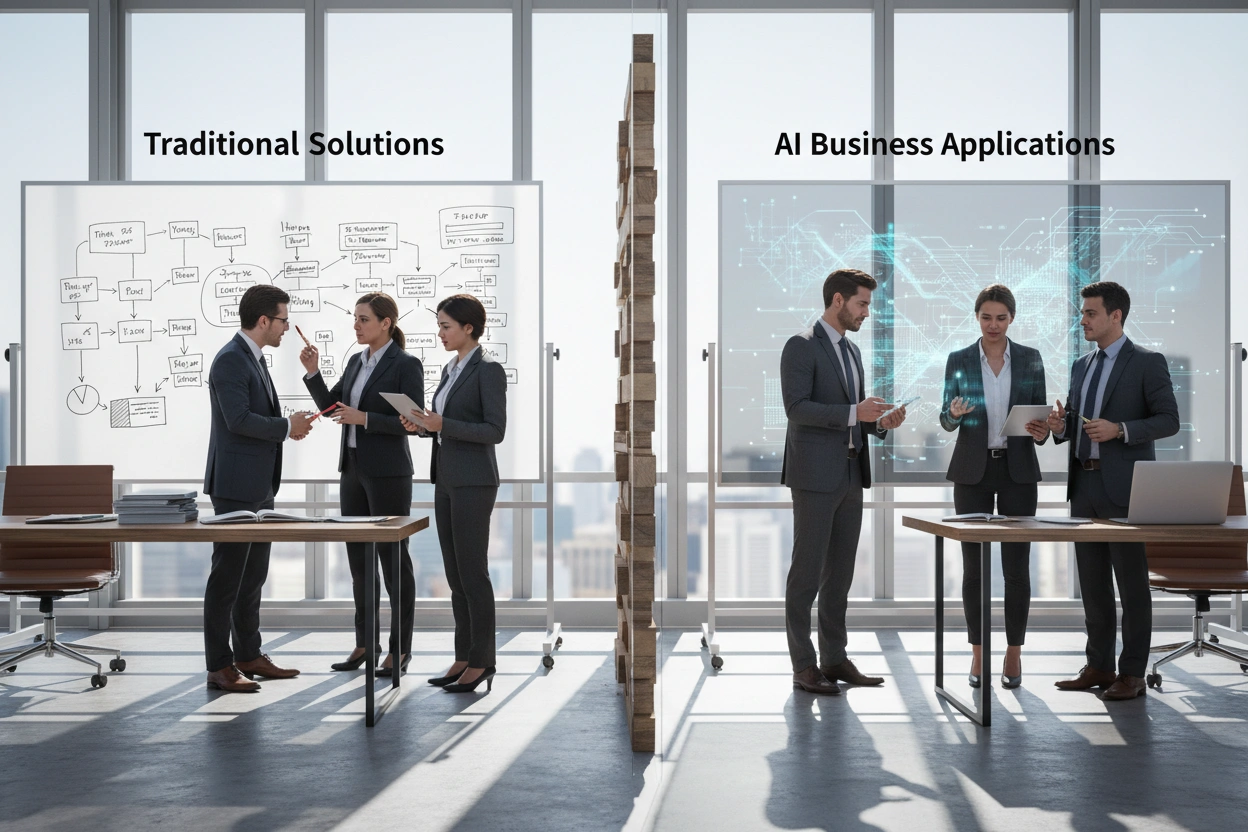
While AI tools offer numerous benefits, traditional solutions still play a significant role in many businesses. Understanding their strengths and weaknesses can help SMBs determine the best approach for their specific needs.
Strengths of Traditional Solutions
- Established Processes: Traditional methods often rely on established practices that have been refined over time. This can lead to consistency and reliability in operations.
- Human Touch: Many businesses thrive on personal interactions. Traditional solutions often allow for a more human-centered approach, which can be essential in customer service and relationship management.
- Lower Initial Investment: Implementing traditional solutions may require less financial investment upfront compared to deploying AI technologies, which often involve software licenses, training, and infrastructure upgrades.
Weaknesses of Traditional Solutions
- Inefficiency: Manual processes can be time-consuming and prone to errors, which can hinder productivity.
- Limited Data Utilization: Traditional methods may not leverage data as effectively as AI applications, resulting in missed opportunities for insights and improvements.
- Scalability Challenges: As businesses grow, traditional solutions may struggle to keep pace, requiring significant restructuring or additional resources.
AI Implementation Strategies for SMBs

For SMBs considering the transition to AI, implementing AI business applications efficiently is essential. Here are several strategies to facilitate a smooth integration.
Assess Business Needs
Understanding specific business needs is the first step in AI implementation. This involves:
- Identifying areas where AI could provide the most value, such as customer service, marketing, or operations.
- Evaluating existing processes to determine which can be automated or improved through AI tools.
- Setting clear goals for what the business hopes to achieve with AI integration.
Start Small
Beginning with pilot projects can help minimize risks and manage costs. This approach allows businesses to:
- Test AI applications in a controlled environment.
- Gather feedback and make necessary adjustments before a full-scale rollout.
- Measure the impact of AI on specific business functions.
Invest in Training
Investing in employee training is crucial for successful AI adoption. This includes:
- Providing resources to help staff understand AI tools and their functionalities.
- Encouraging a culture of continuous learning to keep up with technological advancements.
- Offering support during the transition to ensure employees feel confident using new systems.
The Role of Machine Learning in Business Efficiency
Machine learning, a subset of AI, plays a significant role in enhancing business efficiency. By enabling systems to learn from data and improve over time, machine learning can drive substantial improvements across various business functions.
Applications of Machine Learning in Business
- Customer Insights: Machine learning algorithms can analyze customer behavior and preferences, allowing businesses to tailor their offerings and marketing strategies.
- Fraud Detection: In finance and e-commerce, machine learning models can identify unusual patterns indicative of fraudulent activity, helping to mitigate risks.
- Supply Chain Optimization: By analyzing historical data, machine learning can forecast demand, optimize inventory levels, and streamline logistics.
Common Pitfalls of Implementing Machine Learning
While machine learning offers numerous benefits, several pitfalls can hinder its effectiveness:
- Insufficient Data: Machine learning models rely heavily on data quality. Insufficient or poor-quality data can lead to inaccurate predictions.
- Overfitting: This occurs when a model is too complex, capturing noise instead of the underlying patterns. Regularization techniques and cross-validation can help mitigate this issue.
- Neglecting Human Oversight: Relying solely on machine learning without human intervention can lead to unintended consequences. Ensuring that human judgment is part of the decision-making process is essential.
Comparing AI Tools and Traditional Solutions: A Decision Matrix
When deciding between AI tools and traditional solutions, it can be helpful to use a decision matrix. This matrix evaluates critical factors to determine the most suitable approach for a business.
Factors to Consider
- Cost: Analyze the initial and ongoing costs associated with each solution.
- Scalability: Consider how well each option can grow with the business.
- Ease of Implementation: Evaluate the complexity of integrating the solution into existing workflows.
- Return on Investment (ROI): Estimate the potential benefits of each approach and how they align with business goals.
Example Decision Matrix
| Factor | AI Tools | Traditional Solutions |
|---|---|---|
| Cost | Higher initial investment | Lower initial investment |
| Scalability | Highly scalable | Limited scalability |
| Ease of Implementation | Complex integration | Straightforward integration |
| ROI | Potentially high | Steady but limited returns |
By analyzing these factors, SMB owners can make more informed decisions about which solution best aligns with their operational needs and long-term goals.
The Future of Business Efficiency
The landscape of business operations continues to evolve, with emerging AI business applications becoming increasingly integral. As technology advances, the gap between AI tools and traditional solutions may narrow. However, understanding the unique strengths of each can empower SMB owners to leverage them effectively.
Keeping Up with Trends
Staying informed about industry trends is crucial for businesses looking to remain competitive. Some key trends to watch include:
- Increased Adoption of AI in SMBs: As AI tools become more accessible, more SMBs are likely to adopt these technologies.
- Integration of AI with Existing Systems: Future developments will likely focus on creating seamless integrations with traditional systems, enhancing overall efficiency.
- Emphasis on Ethical AI: As concerns about data privacy and ethical considerations grow, businesses will need to ensure that their AI implementations align with best practices and regulations.
Leveraging Insights for Business Growth
The integration of AI business applications offers SMBs a pathway to enhance efficiency and decision-making. By understanding the strengths and weaknesses of both AI tools and traditional solutions, business owners can strategically implement technologies that align with their objectives.
How GuacRich Can Help
GuacRich specializes in providing insights and solutions that help SMBs navigate the complexities of integrating AI into their operations. By leveraging our expertise, businesses can streamline their processes, enhance decision-making, and ultimately drive growth.
For those looking to elevate their business efficiency through AI business applications in action, consider reaching out for tailored support.
Take Action with GuacRich
Understanding the potential of AI tools and their comparison to traditional solutions is the first step toward enhancing business efficiency. To explore how GuacRich can assist you in implementing effective AI strategies, contact GuacRich today. Let’s work together to optimize your operations and achieve your business goals.
Subscribe to our weekly newsletter
Lorem ipsum dolor sit amet consectetur elementum laoreet vitae suspendisse ullamcorper ut integer lectus lacus.
