
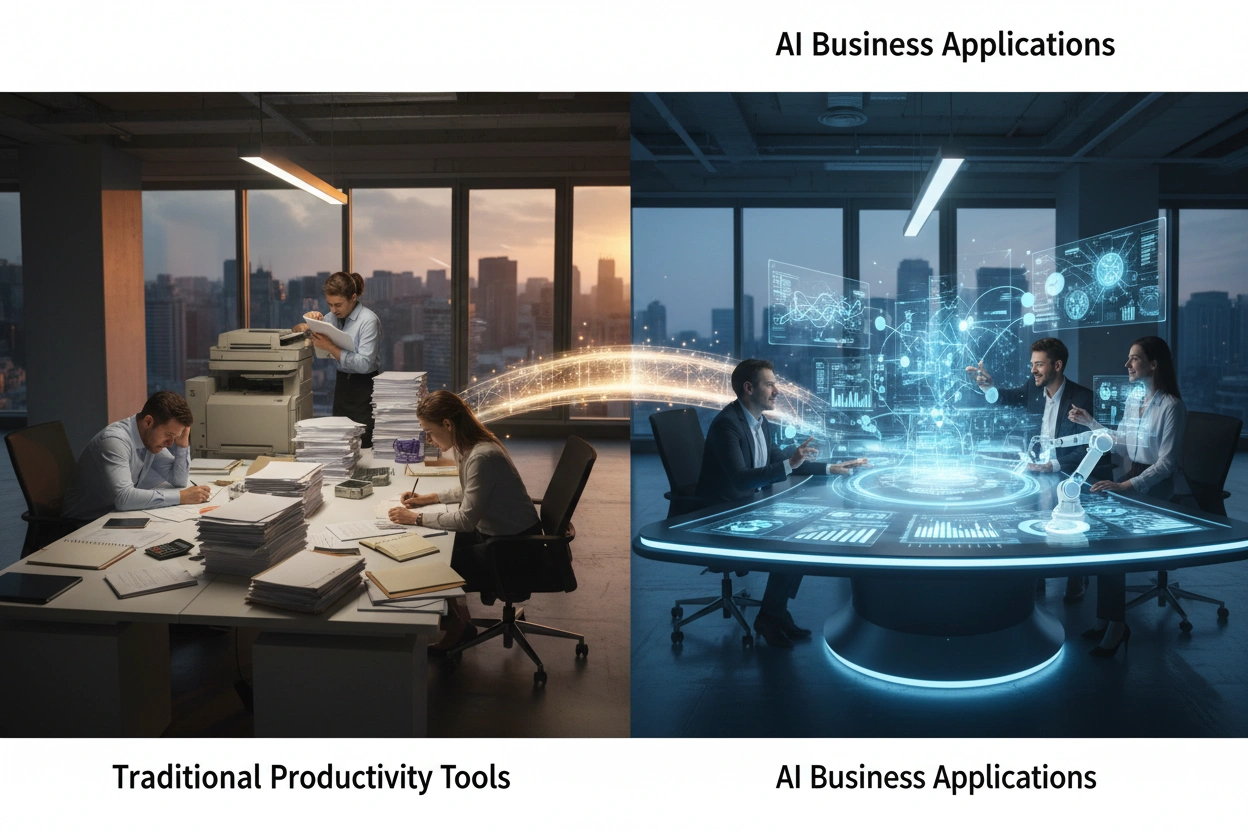
In the rapidly evolving landscape of business technology, the emergence of AI business applications and traditional productivity tools has sparked a significant transformation in how organizations operate. As of 2026, the integration of artificial intelligence (AI) and machine learning in business processes is no longer a luxury but a necessity for growth-minded small and medium-sized businesses (SMBs). This article examines the differences between AI business applications and traditional productivity tools, highlighting the benefits, implementation strategies, and practical insights for leveraging AI effectively.
Understanding AI Business Applications

AI business applications utilize advanced algorithms and machine learning techniques to automate tasks, analyze data, and provide insights that drive decision-making. Unlike traditional productivity tools, which often rely on manual input and basic automation, AI applications can learn from data patterns, adapt to changing conditions, and optimize workflows.
Key Features of AI Business Applications
- Automation: AI applications can automate repetitive tasks, such as data entry, scheduling, and customer inquiries. This allows employees to focus on higher-value activities, enhancing overall productivity.
- Predictive Analytics: By analyzing historical data, AI can forecast trends, customer behaviors, and market changes, enabling businesses to make informed decisions.
- Personalization: AI can tailor experiences for customers by analyzing their preferences and behaviors, leading to improved customer satisfaction and loyalty.
Common Use Cases for AI in Business
- Customer Relationship Management (CRM): AI-driven CRMs can analyze customer interactions and provide personalized recommendations, helping businesses build stronger relationships.
- Supply Chain Optimization: AI applications can predict demand fluctuations, optimize inventory levels, and streamline logistics, reducing costs and improving efficiency.
- Human Resources Management: AI tools can assist in recruitment by screening resumes, scheduling interviews, and analyzing candidate fit based on historical hiring data.
Traditional Productivity Tools: An Overview

Traditional productivity tools, such as spreadsheets, project management software, and email platforms, have served as the backbone of business operations for decades. While they are effective for basic tasks, they often lack the advanced capabilities offered by AI business applications.
Limitations of Traditional Tools
- Manual Data Entry: Traditional tools often require significant manual input, which can lead to errors and inefficiencies.
- Static Analysis: These tools typically provide static reports that do not adapt or evolve based on new data, limiting their usefulness for strategic decision-making.
- Limited Integration: Many traditional tools operate in silos, making it challenging to integrate data across different platforms and departments.
Common Use Cases for Traditional Productivity Tools
- Project Management: Tools like Trello and Asana help teams manage tasks and deadlines but lack the predictive capabilities of AI applications.
- Document Creation: Word processors and spreadsheets are essential for creating and managing documents but do not provide insights based on the data they contain.
- Email Communication: Email remains a primary communication tool, but it does not offer the intelligent automation features that AI can provide.
Comparing AI Business Applications and Traditional Productivity Tools

Understanding the distinctions between AI business applications and traditional productivity tools is vital for SMBs aiming to enhance efficiency and decision-making. Here are some key differences:
1. Automation Capabilities
AI business applications excel in automating complex tasks that require data analysis and decision-making. Traditional tools, while capable of basic automation, often fall short in processing large datasets or adapting to new information.
2. Data Analysis and Insights
AI applications leverage machine learning to provide predictive analytics and insights that can guide strategic decisions. In contrast, traditional tools typically offer retrospective analysis, which may not be as useful in a fast-paced business environment.
3. User Experience
AI business applications often feature user-friendly interfaces that adapt to user behavior, providing personalized experiences. Traditional tools may require extensive training and do not always adjust to individual user needs.
4. Cost Efficiency
While the initial investment in AI technology may be higher, the long-term savings from improved efficiency and reduced labor costs can outweigh these expenses. Traditional tools may have lower upfront costs but can lead to increased labor and error-related expenses over time.
AI Implementation Strategies for SMBs
AI business applications present an opportunity for SMBs to enhance operational efficiency and drive growth. By understanding the differences between these advanced tools and traditional productivity solutions, businesses can make informed decisions about their technology investments.
Implementing AI business applications can seem daunting, but with a clear strategy, SMBs can successfully integrate these technologies into their operations. Here are essential strategies for implementing AI business applications:
Step 1: Identify Business Needs
Begin by assessing the specific areas where AI can add value. Consider factors such as workflow inefficiencies, data management challenges, and customer interaction points.
Step 2: Research AI Solutions
Investigate various AI business applications that align with your identified needs. Look for solutions that offer scalability, integration capabilities, and user-friendly interfaces.
Step 3: Develop a Pilot Program
Before a full-scale implementation, consider running a pilot program with a select group of users. This approach allows you to test the application, gather feedback, and make necessary adjustments.
Step 4: Train Employees
Effective training is critical to ensure that employees can utilize AI applications to their fullest potential. Provide comprehensive training sessions and ongoing support to facilitate a smooth transition.
Step 5: Monitor and Evaluate
After implementation, continuously monitor the performance of AI applications and evaluate their impact on business operations. Use metrics such as productivity levels, customer satisfaction, and cost savings to assess success.
Common Misconceptions About AI in Business
As AI business applications become more prevalent, several misconceptions persist that can hinder their adoption. Addressing these misunderstandings is essential for successful implementation.
Misconception 1: AI Will Replace Human Jobs
Many fear that AI will lead to widespread job losses. In reality, AI is designed to augment human capabilities, allowing employees to focus on more strategic tasks rather than mundane ones.
Misconception 2: AI is Only for Large Enterprises
While larger companies have been early adopters of AI, numerous affordable solutions are available for SMBs. These applications can be tailored to fit smaller operations without the need for extensive resources.
Misconception 3: AI Implementation is Too Complex
AI technology has advanced significantly, and many applications now offer user-friendly interfaces and robust support. With proper training and resources, SMBs can navigate the implementation process effectively.
The Future of AI Business Applications
As AI technology continues to evolve, its impact on business productivity will only grow. Emerging trends to watch for include:
- Increased Integration: Future AI applications will likely offer seamless integration with existing tools, enabling a more cohesive workflow.
- Greater Personalization: AI will continue to refine its ability to deliver personalized experiences based on user behavior and preferences.
- Enhanced Security Features: As businesses become more data-driven, AI applications will increasingly focus on security measures to protect sensitive information.
The Intersection of AI and Business Efficiency
AI business applications present an opportunity for SMBs to enhance operational efficiency and drive growth. By understanding the differences between these advanced tools and traditional productivity solutions, businesses can make informed decisions about their technology investments.
GuacRich is committed to helping SMB owners and operators navigate this evolving landscape. Whether you are looking to implement AI solutions or seeking guidance on optimizing existing processes, GuacRich can provide the expertise and resources necessary for success.
For more insights on integrating AI into your business strategy, contact GuacRich today.
Subscribe to our weekly newsletter
Lorem ipsum dolor sit amet consectetur elementum laoreet vitae suspendisse ullamcorper ut integer lectus lacus.
