

As businesses increasingly turn to technology for solutions, AI business applications have emerged as a powerful tool for enhancing productivity, improving decision-making, and streamlining operations. In 2026, organizations are leveraging AI tools for productivity to stay competitive and drive growth. This guide provides a comprehensive look at implementing AI business applications, comparing them with traditional tools, and offering actionable insights for small and medium-sized businesses (SMBs) seeking to harness AI effectively.
Understanding AI Business Applications

AI business applications refer to software solutions that utilize artificial intelligence to automate processes, analyze data, and enhance user experience. These applications span various functions, including customer service, marketing, human resources, and finance. The primary advantage of AI business applications lies in their ability to process vast amounts of data quickly, providing insights and recommendations that would be impossible for humans to achieve in a timely manner.
In contrast to traditional tools, AI applications adapt and learn from data inputs over time. This capability allows businesses to make data-driven decisions, forecast trends, and optimize operations. For instance, AI-driven analytics tools can assess customer behavior and preferences, enabling more personalized marketing strategies that resonate with target audiences.
Key Features of AI Business Applications
- Automation: AI applications can automate repetitive tasks, freeing up human resources for more strategic activities.
- Data Analysis: These tools can analyze large datasets, identifying patterns and trends that inform business decisions.
- Predictive Analytics: AI applications can forecast future outcomes based on historical data, allowing businesses to anticipate market shifts.
- Natural Language Processing (NLP): This technology enables AI to understand and respond to human language, enhancing customer interactions through chatbots and virtual assistants.
Benefits of Implementing AI Business Applications
The implementation of AI business applications offers several benefits for SMBs:
- Increased Efficiency: By automating routine tasks, businesses can operate more efficiently, reducing time and resource expenditure.
- Enhanced Decision-Making: Access to real-time data and predictive analytics empowers businesses to make informed decisions quickly.
- Cost Savings: Automating processes can lead to significant cost reductions in labor and operational expenses.
- Improved Customer Experience: AI tools for productivity can provide personalized interactions, enhancing customer satisfaction and loyalty.
AI vs. Traditional Tools
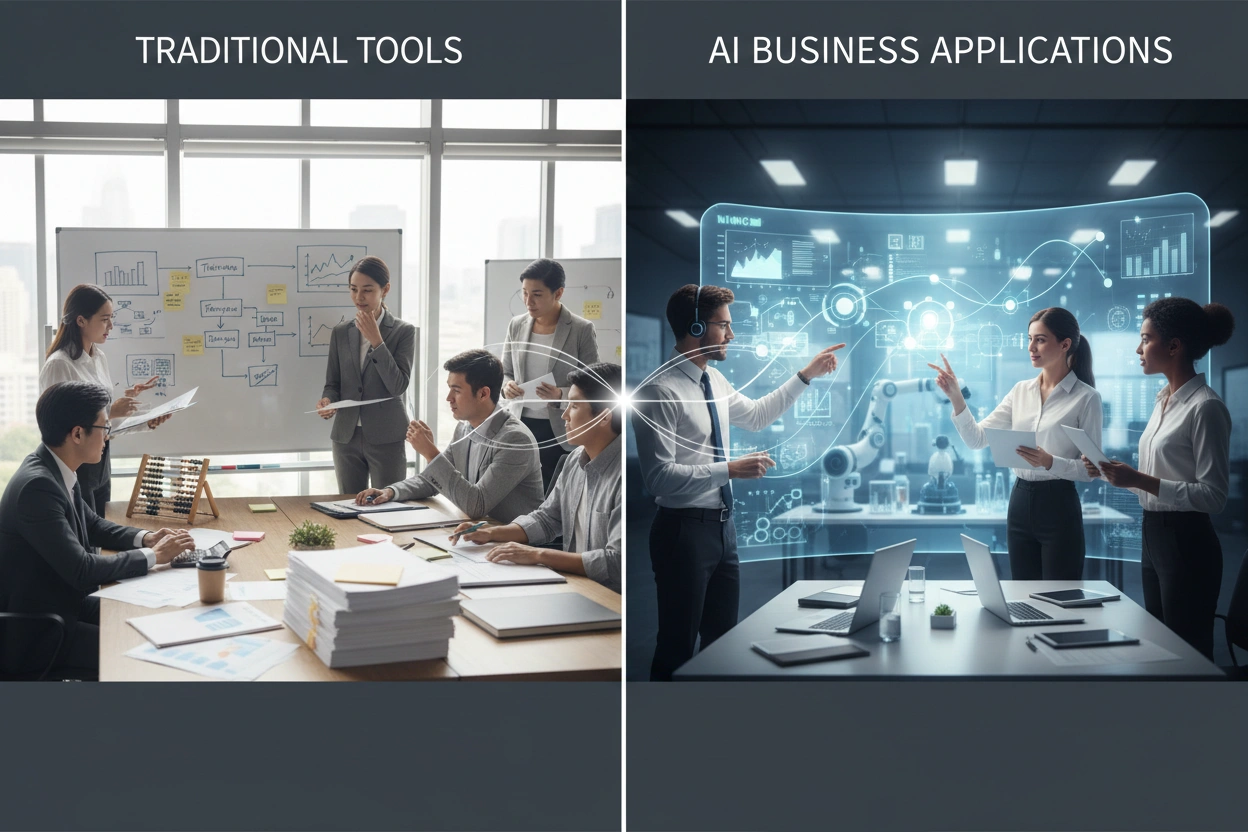
Understanding the differences between AI business applications and traditional tools is essential for businesses considering a transition. Traditional tools often rely on manual inputs and predefined algorithms, limiting their ability to adapt to changing conditions. In contrast, AI business applications leverage machine learning and data analysis, enabling them to evolve over time.
Comparison of Key Features
Adaptability:
- Traditional tools require manual updates and adjustments.
- AI applications learn from data and adapt automatically.
Data Processing:
- Traditional tools can handle limited data sets.
- AI applications process vast amounts of data in real-time.
User Interaction:
- Traditional tools often require user training and expertise.
- AI tools utilize intuitive interfaces and natural language processing for ease of use.
Cost:
- Traditional tools may incur high operational costs due to manual processes.
- AI applications can lead to cost savings through automation and efficiency.
Step-by-Step Guide to Implementing AI Business Applications

Implementing AI business applications requires careful planning and execution. Follow these essential steps:
Identify Business Needs: Begin by assessing specific business challenges that AI can address. Consider areas such as customer service, data management, or operational efficiency.
Research Available Solutions: Investigate various AI tools that align with your identified needs. Look for software that offers features relevant to your business operations.
Evaluate Integration Options: Ensure that the chosen AI applications can integrate seamlessly with existing systems. Compatibility is crucial for a smooth transition and maximum benefit.
Develop a Pilot Program: Before full-scale implementation, consider running a pilot program. This approach allows you to test the effectiveness of the AI solution in a controlled environment.
Train Your Team: Equip your staff with the necessary training to use the AI tools effectively. This training should focus on understanding the technology and how it enhances their roles.
Monitor and Adjust: After implementation, continuously monitor the performance of the AI applications. Be prepared to make adjustments based on feedback and changing business needs.
Common Mistakes to Avoid
When implementing AI business applications, businesses often encounter pitfalls. Here are some common mistakes and how to avoid them:
- Neglecting Data Quality: Ensure that the data fed into AI systems is clean and relevant. Poor data quality can lead to inaccurate insights.
- Ignoring User Adoption: Involve employees in the selection and implementation process to foster buy-in and ease the transition.
- Overlooking Compliance and Security: Address any legal or security concerns related to data handling and AI usage to protect your business and customers.
The Role of AI Tools for Productivity
AI tools for productivity play a pivotal role in enhancing business operations. These tools streamline workflows, automate mundane tasks, and provide insights that drive efficiency.
Types of AI Tools for Productivity
- Chatbots: Automate customer service inquiries, providing instant responses and freeing up human agents for complex issues.
- Project Management Tools: Use AI to assign tasks, track progress, and predict project completion times based on historical data.
- Data Analytics Platforms: Analyze business performance metrics and customer behavior to inform strategic decisions.
Implementing AI Tools for Productivity
To effectively implement AI tools for productivity, consider the following:
Define Objectives: Clearly outline what you hope to achieve with AI tools, whether it's improving response times or increasing sales.
Choose the Right Tool: Select tools that align with your objectives and integrate well with existing systems.
Train Employees: Provide training sessions to ensure that employees understand how to leverage AI tools effectively.
Gather Feedback: Regularly solicit feedback from users to identify areas for improvement and ensure the tools meet business needs.
Conclusion: The Future of AI Business Applications with GuacRich
AI business applications represent a significant opportunity for SMBs to enhance productivity, streamline operations, and make informed decisions. By understanding the capabilities of AI tools and carefully implementing them, businesses can transform their processes and improve outcomes.
GuacRich is dedicated to helping SMBs navigate the complexities of AI integration. Our expertise can guide you through the process, ensuring that you leverage AI business applications to their fullest potential.
For more information on how to implement AI business applications tailored to your needs, contact GuacRich today.
Subscribe to our weekly newsletter
Lorem ipsum dolor sit amet consectetur elementum laoreet vitae suspendisse ullamcorper ut integer lectus lacus.
